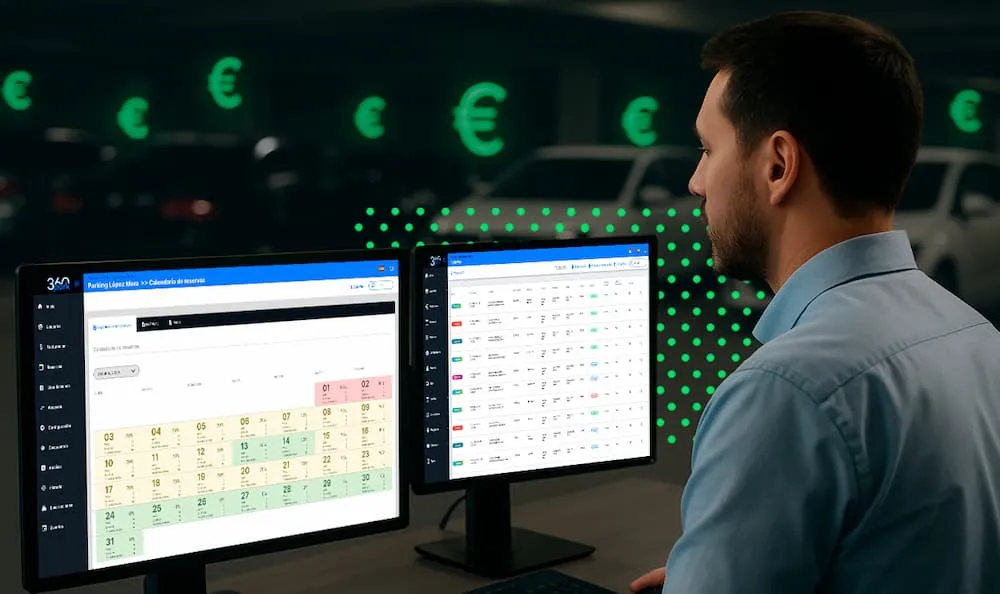
How to monetize data in parkings: from access control to occupancy map
Parking management is experiencing a true digital transformation. Thanks to smart access control systems, sensors and centralized platforms, parkings generate a huge amount of information every day. These data not only serve to manage daily operations, but also open the door to a new business model: monetizing data in parkings. Thus, in this article we explore how to transform the information generated by parkings into real revenue. From basic entry and exit control to the creation of occupancy maps and value-added services.
Keys to monetize data in parkings
The first phase of any smart parking is to have a reliable access control system. Technologies such as license plate reading, mobile accesses or ticketless systems not only speed up the entry and exit of vehicles. On the other hand, they also let you collect key data:
- Time of entry and exit.
- License plate and type of vehicle.
- Length of stay.
- Type of client (subscriber, rotational, reservation).
These structured data are the basis for understanding how the parking is used and how parking management can be optimized. Centralized platforms like i+D3 allow monitoring all these processes in real time, unifying accesses, exits, payments and reservations in a single panel. In this way, comprehensive control turns the parking into a true data center.
Reservations and subscribers: another source of value to monetize data in parkings
Access data is enriched with information about reservations and subscribers. When reservations are managed centrally—whether they come from the own website or from external operators—a complete view of demand is obtained. In this way, it allows:
- Anticipating occupancy levels.
- Predicting monthly revenue.
- Analyzing recurrence patterns.
Integrating all these sources into a single parking management platform makes the data consistent and ready to be exploited.
Occupancy maps: visualization and prediction
The next step to monetize data in parkings is to transform the information into useful visualizations, such as occupancy maps by hours, days or zones. Therefore, with them you can detect:
- Demand peaks and off-peak hours.
- Underutilized areas of the parking.
- Seasonal usage trends.
An occupancy map improves internal decision making and can become a data product for third parties. From mobility apps to public administrations interested in urban management.
Models to monetize data in parkings
Once the information is organized and visualized, the key moment arrives: monetizing the data in parkings. In this way, there are different exploitation models:
1. Internal optimization
The most immediate monetization is to reduce costs and increase revenue, adjusting dynamic rates, optimizing personnel or redistributing spaces. Thus, a more efficient use of space increases profitability without the need to expand infrastructures.
2. Sale of data to third parties
The aggregated and anonymized data of occupancy are valuable for:
- Public administrations planning mobility.
- Transport or micromobility companies.
- Navigation and parking apps that need information in real time.
A practical example is offering a mobility application access to a live occupancy panel of your parking or parking network.
3. Premium services for clients
On the other hand, the information can also be monetized directly with the end user:
- Subscriptions with guaranteed access during high demand hours.
- Real-time alerts when a spot becomes available.
- Advance reservations with preferential rates.
4. Synergies with local businesses
Data on schedules and customer profiles allow creating cross campaigns with local businesses. In this way, they offer discounts to users who park and generate shared revenue.
Challenges and best practices
Although the opportunities are clear, it is essential to approach monetization responsibly:
- Comply with data protection regulations (GDPR).
- Anonymize and aggregate information before sharing it.
- Guarantee the quality and reliability of the captured data.
- Define clear agreements with partners and clients.
Likewise, with these bases it will be achieved that the data are a sustainable source of revenue and trust.
Join the parking management of the future with i+D3
In conclusion, parkings are no longer mere spaces to leave the car. They are true data centers capable of generating strategic information about urban mobility. Moving from simple access control to the exploitation of occupancy maps is the key to opening new business lines. With solutions like the centralized platform of i+D3, parking managers can take the leap towards data monetization. Thus, they optimize the profitability of their facilities and actively participate in the smart mobility ecosystem. Do you want to discover how to apply these models in your parking? At i+D3 we help you design the best strategy to transform your data into value.