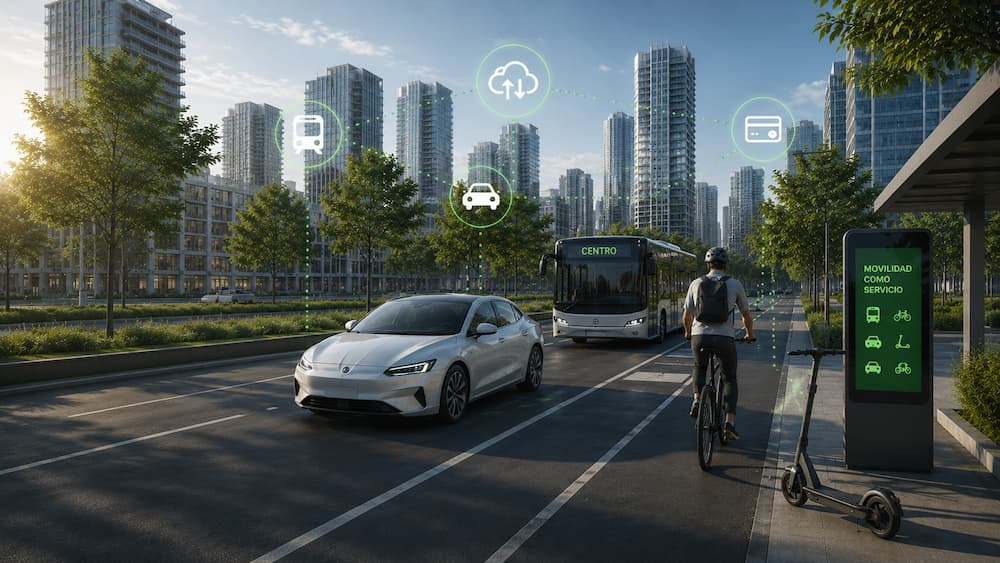
Mobility as a service: integration and technological challenges
Urban mobility is evolving rapidly thanks to digitalization, connectivity and the rise of smart cities. Thus, Mobility as a Service is one of the most innovative models to transform travel. Integrating different means of transport into a single digital platform allows offering a more efficient, sustainable and personalized experience. However, achieving this level of integration requires overcoming significant technological challenges related to interoperability, data management and cybersecurity. From i+D3 we play a key role in this process. Do you want to know how? Keep reading!
What is mobility as a service (MaaS)?
Mobility as a service is a model that integrates different transport options within the same technological platform. The user can plan, reserve and pay for trips using a single application. Thus, this approach allows combining:
- Public transport.
- Shared vehicles.
- Bicycles and electric scooters.
- Taxi or VTC services.
- Corporate mobility solutions.
In this way, the objective is to offer more flexible mobility and optimize urban travel.
Benefits of mobility as a service
To begin with, the implementation of MaaS platforms provides advantages for citizens as well as for administrations and transport operators.
Better user experience
Centralized platforms simplify route planning and allow access to multiple services from a single digital interface.
More sustainable mobility
MaaS favors the use of sustainable alternatives and contributes to reducing urban congestion and polluting emissions.
Optimization of urban resources
The collection and analysis of data in real time facilitates a more efficient management of traffic and transport.
Cost reduction
Shared mobility models allow optimizing resources and reducing costs associated with the use and maintenance of private vehicles.
The great technological challenges of mobility as a service
Integration between platforms and operators
One of the biggest challenges is the interoperability between systems of different transport providers. Each operator may use different technologies, APIs and data structures. However, for this it is necessary to develop open and scalable architectures capable of connecting:
- Public transport platforms.
- Payment systems.
- Mobile applications.
- IoT sensors.
- Smart urban infrastructures.
In this area, i+D3 develops solutions that facilitate interoperability between systems and improve service connectivity.
Smart data management
MaaS platforms generate huge volumes of information from multiple sources:
- Geolocation.
- Urban sensors.
- Mobile applications.
- Traffic systems.
- Payment platforms.
Likewise, the ability to process data in real time is essential to offer optimized routes and improve the user experience. In this way, i+D3 bets on solutions based on data analytics and artificial intelligence. Thus, it allows companies and administrations to optimize processes, anticipate incidents and improve operational efficiency.
Cybersecurity and data protection
Guaranteeing the security of MaaS platforms is one of the main technological challenges today. Likewise, solutions must incorporate:
- Secure authentication systems.
- Data encryption.
- Continuous monitoring.
- GDPR regulatory compliance.
In this way, i+D3 integrates cybersecurity solutions adapted to complex digital environments. Therefore, it protects technological infrastructures and guarantees the continuity of services.
Scalable infrastructures and connectivity
The growth of smart cities requires platforms capable of supporting thousands of simultaneous connections and responding in real time. Thanks to its experience in digital transformation, i+D3 develops cloud solutions and advanced technological infrastructures aimed at improving efficiency.
Smart mobility and cities of the future
On the other hand, mobility as a service will be one of the fundamental pillars of Smart Cities. The combination of connectivity, automation and data analysis will allow building more sustainable and efficient cities. The incorporation of technologies such as:
- Internet of Things (IoT).
- Artificial Intelligence.
- Autonomous vehicles.
- Predictive platforms.
will completely transform the management of urban mobility in the coming years. I+D3 contributes to the development of digital solutions capable of accelerating the transformation of cities and improving the mobility experience.
The future is in mobility as a service
Mobility as a service represents a new way of understanding urban transport: more connected, efficient and sustainable. However, its success will depend on the ability to integrate technologies, guarantee security and manage data in real time. Thus, collaboration between administrations, operators and technology companies will be key to adapting to the needs of the future. I+D3, your strategic technological partner to face the challenges of smart mobility and connected cities.