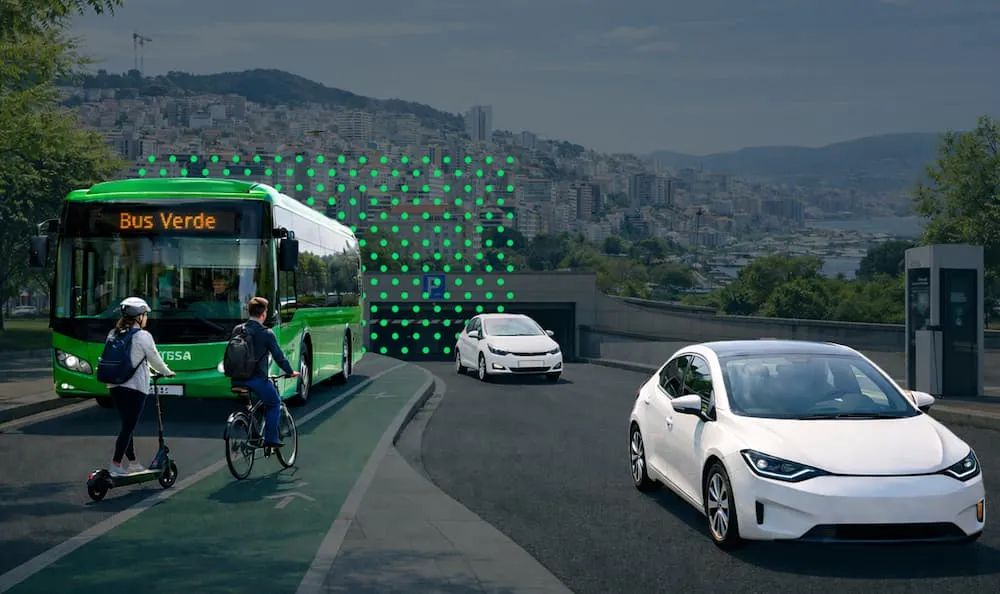
Urban mobility trends 2026: towards smarter, cleaner and more connected cities
Urban mobility is experiencing one of the most profound transformations of recent decades. City growth and technological evolution are forcing a rethink of how we travel and how urban spaces are designed. Looking ahead to 2026, mobility trends point to a more sustainable, digital and people-centric model. In this article we analyze the main keys that will mark mobility in 2026. In addition to how these trends will impact public administrations, companies and citizens.
Electrification and decarbonization of transport
Electrification is consolidated as one of the pillars of urban mobility. In 2026, electric vehicles will dominate the private sphere, and also public transport and urban delivery services. Electric buses, zero-emission taxis and electric carsharing systems will significantly reduce CO₂ emissions. In this way, air quality is improved and noise in cities is reduced. Mobility thus advances towards a cleaner model, aligned with European and global climate objectives.
Low emission zones and new regulations in urban mobility
The Low Emission Zones (LEZ) are already a reality and in 2026 they will have an even more relevant role. These areas restrict the circulation of polluting vehicles and encourage the use of more sustainable alternatives. Urban mobility will be conditioned by stricter regulations. Thus, they will boost public transport, micromobility and walking trips. In this way, adapting to this scenario will be key to maintaining accessibility and efficiency in daily travel.
Digitalization and integrated urban mobility platforms
Technology will be a central element in the mobility of the future. Mobility as a Service (MaaS) platforms will allow planning, booking and paying from a single application. In 2026, urban mobility will be increasingly multimodal. Therefore, it will combine metro, bus, bicycle, scooter or shared car in a simple and personalized way. The use of data in real time will allow optimizing routes, reducing waiting times and improving the user experience.
The rise of the 15-minute city
The 15-minute city concept is gaining strength as an urban and mobility model. This approach bets on neighborhoods where essential services are within walking or cycling distance. This model reduces dependence on the private car, decreases congestion and favors a healthier and more balanced urban life. In 2026, many cities will integrate this concept into their mobility and urban development plans.
Micromobility and first and last mile solutions
Micromobility will continue to be one of the great protagonists of urban mobility. Electric bicycles, scooters and other light vehicles are the ideal solution for short trips and for connecting with public transport. Proper regulation and the creation of safe infrastructures are key. This includes bike lanes and shared zones. Thus, these means will be integrated efficiently and safely into the city.
Smart traffic management and use of data
Urban mobility in 2026 will be strongly supported by smart traffic management. Sensors, artificial intelligence and data analysis will allow anticipating congestion, optimizing traffic lights and improving road safety. Thanks to these technologies, cities will be able to make decisions based on real data, improving the efficiency of the transport system and reducing travel times.
Autonomous vehicles and new urban mobility models
Although their implementation will be progressive, autonomous vehicles will begin to integrate into mobility through pilot projects. Especially in services such as robotaxis or on-demand transport. These new models promise more flexible, efficient and accessible urban mobility, although they will still have to overcome regulatory and technological challenges.
A new paradigm for urban mobility
In 2026, urban mobility will be more sustainable, digital and people-centric. The combination of electrification, technology, urban planning and changes in mobility habits is giving rise to more livable cities. Adapting to these trends is a matter of innovation. In addition to an opportunity to improve the quality of urban life and build cities designed for collective well-being.