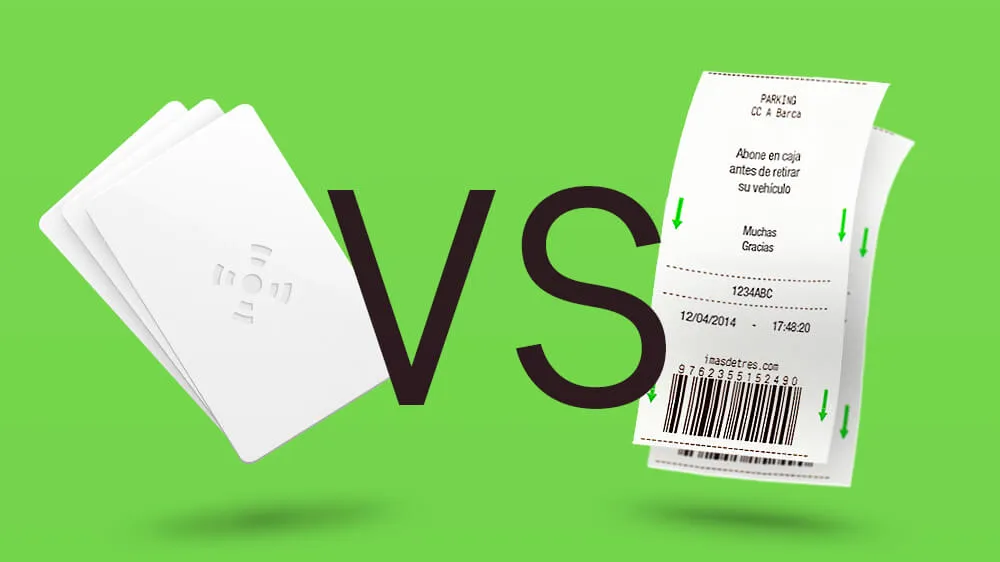
Paper or plastic parking tickets: which should you choose?
The choice between paper parking tickets and plastic cards affects purchase costs, maintenance and daily operations.
Paper tickets remain common in short-stay facilities, while reusable cards can make sense where collection and recovery systems are available.
Neither option suits every car park. Consider traffic levels, customer needs and existing access equipment.
We compare the benefits, limitations and costs of each approach to help you identify the best fit for your facility.
What is the difference between paper tickets and plastic parking cards?
Both can identify vehicles or parking stays, but their operation and maintenance differ.
Paper parking tickets
Thermal paper tickets are produced by printers installed in car park entrance terminals.
They can include entry date and time, a barcode or QR code and other information associated with the stay.
Main advantages include:
- Fast issue: a separate ticket is printed for each stay.
- Visible information: useful details can be printed for the driver.
- Easy replenishment: staff replace the paper roll when necessary.
- Integration with other services: printed codes can identify stays, apply discounts or enable digital payments when supported by the software.
Paper tickets require regular roll changes and printer maintenance.
Reusable plastic cards
Reusable plastic cards can identify a parking stay and be returned to the system when the stay ends.
The principal benefit is repeated use, reducing consumption of disposable media.
However, operators must collect and reuse cards. Card dispensers and return mechanisms also need maintenance.
Losses, damage and failure to return cards can increase operating costs.
Reusable parking cards are not the same as RFID or MIFARE access cards. Subscribers may use the latter, and the systems work differently.
Paper tickets versus plastic cards: key differences
Before choosing a medium, consider its operational impact.
| Criterion | Paper tickets | Reusable plastic cards |
|---|---|---|
| Initial investment | Depends on the printer and equipment. | Depends on the dispenser and recovery system. |
| Consumables | Continuous roll replacement. | Replacement when lost or damaged. |
| Reuse | Usually single-use. | Suitable for repeated use. |
| Visible information | Variable data can be printed. | Depends on the card type. |
| Maintenance | Printer and cutting mechanisms. | Dispenser, collection and recovery. |
| High turnover | Usually suitable. | Card availability must be managed. |
| Digital integration | Through codes and identifiers. | Depends on technology and compatibility. |
Costs depend on how many transactions you process, how long each card lasts and what maintenance is needed.
Which ticket system is more cost-effective for a car park?
Parking ticket costs go beyond paper or card prices. Equipment and resources required for operation also matter.
Equipment investment and dispensing capacity
Paper ticket and plastic card dispensers can have different costs depending on their components and capabilities.
With paper systems, capacity depends on the size and format of the roll. For example, the i+d3 S300 access control terminal holds up to 4,500 tickets per roll, reducing replenishment frequency.
With reusable cards, capacity depends on the dispenser and the number of cards available in circulation.
At high-turnover car parks, this is especially important to prevent interruptions.
Maintenance and replacement costs
Paper tickets create recurring consumable costs. Printers and their components also require regular maintenance.
Reusable cards may reduce the need for new media, but require collection, cleaning when necessary and replacement if lost or damaged.
Before comparing prices, calculate the total lifetime cost of each option, including equipment, consumables, maintenance and staff time.
Which is more sustainable: paper tickets or plastic cards?
Sustainability is another consideration when choosing a parking ticket system.
Paper tickets generate waste with every transaction, whereas plastic cards can be used many times before replacement.
However, reusable does not automatically mean more sustainable. Manufacturing, lifespan, recovery rates and disposal all affect the environmental impact of each option.
For thermal paper, it is also important to check its composition and available recycling options.
Assess the entire life cycle rather than focusing solely on the material used.
Which ticket type suits different car parks?
The choice mainly depends on user profiles and how frequently each medium is used.
High-turnover car parks
In public car parks, hospitals, shopping centres and stations with frequent vehicle movements, paper tickets make it easy to issue individual identifiers without having to recover them.
High-capacity equipment and straightforward roll replacement are especially valuable in these facilities.
Car parks with subscribers and frequent users
Where the same users enter regularly, RFID or MIFARE cards may offer a practical alternative.
These credentials identify authorised customers and connect access events with permissions, schedules and usage conditions, depending on the management system.
A new ticket is not needed for every entry.
Car parks serving different customer groups
Many facilities accommodate occasional users, subscribers, employees and customers with bookings.
It is therefore not always necessary to choose only one identification method.
A hybrid system may combine paper tickets, RFID cards, QR codes and number plate recognition, adapting access to each user group.
What if the car park operates without physical tickets?
Technologies are also available to identify drivers or vehicles without issuing a paper ticket or plastic card.
Ticketless systems use number plate recognition, QR codes or digital credentials to manage entry and parking stays.
These can reduce physical media consumption and simplify certain tasks, although the technology investment, equipment compatibility and incident handling must be evaluated.
To explore this option, see our article comparing traditional and ticketless technology in parking management.
Frequently asked questions about parking tickets
How many paper tickets can a parking machine issue?
It depends on the equipment and roll format. Some entrance terminals, such as the i+d3 S300, can issue up to 4,500 tickets from one roll according to the manufacturer's specifications.
Can paper tickets be used for mobile payments?
Yes, provided the system supports it. The printed barcode or QR code can identify a stay and connect it with a compatible mobile payment service.
Are RFID cards the same as reusable plastic cards?
Not necessarily. RFID is an identification technology that can be embedded in reusable cards. In parking facilities, it is commonly used for subscribers and authorised users, whereas other plastic cards can serve as recoverable media for short-stay parking.
Must equipment be replaced to use another ticket type?
It depends on the compatibility of existing dispensers, readers and software. Some terminals accept multiple identification methods; others need certain components modified or replaced.
Choose the right access system for your car park
Choosing paper, plastic cards or digital media should reflect the actual needs of the facility.
It is not merely a comparison of consumables: investment, maintenance, user profiles and upgrade options matter as well.
At i+d3, we develop parking access control solutions that combine tickets, RFID cards, QR codes and number plate recognition according to each installation's configuration.
Upgrading equipment or planning a new car park? Explore our parking access control systems and find the option that best fits your operations.