Preventive car park maintenance: equipment checklist
Preventive car park maintenance helps find problems before equipment breaks down. Barriers, payment machines and cameras need checks suited to their use and location.
A barrier may move unevenly. A printer may collect dust, or a camera may read plates less accurately. Finding these signs early makes repairs easier to plan.
Here is how to organise parking preventive maintenance, what to inspect and how to plan checks.
What is preventive parking maintenance?
Preventive maintenance means carrying out scheduled inspections and actions to keep equipment in working condition.
Corrective maintenance fixes problems after they occur. Preventive maintenance finds wear and unusual behaviour before they disrupt service.
Tasks include cleaning, safety and electrical checks, performance tests and software reviews.
The checklist depends on the equipment. A site with barriers and payment machines needs different checks from one using number plate recognition and mobile payments.
Maintenance should reflect equipment, operating frequency and manufacturer recommendations.
Preventive maintenance checklist for car parks
Planned inspections should cover the access, payment and management components of a facility.
| Equipment or system | What to inspect | Warning signs |
|---|---|---|
| Automatic barriers | Movement, mechanics, connections and safety devices | Irregular opening, noise or abnormal movement |
| Entry and exit terminals | Printers, readers, screens and access tests | Reading, printing or authorisation failures |
| Number plate cameras | Cleanliness, focus and recognition quality | Increasing numbers of unreadable plates |
| Automatic pay stations | Printers, acceptors, dispensers, readers and payment tests | Jams, rejections or recurring errors |
| Intercoms and pedestrian entrances | Communications, audio and opening operations | Difficulty establishing communication |
| Servers and software | System status, versions, connectivity and logs | Disconnections, repeated errors and abnormal responses |
Inspections must be performed by qualified personnel following relevant technical and safety procedures.
What to inspect in each parking system
Automatic barriers and access equipment
Barriers operate repeatedly, especially at high-turnover facilities.
Check mechanical operation, connections, safety components and opening and closing cycles using approved procedures.
Unusual movement, noise and repeated interruptions can indicate the need for inspection.
The fault may involve sensors or connections rather than the main device. Find the cause before replacing parts.
Entry and exit terminals
Terminals may include printers, ticket or QR readers, RFID devices, screens and intercoms.
At ticket-based sites, printer cleaning is important because dust and paper debris accumulate.
Also confirm that readers identify valid credentials and communicate with the management system.
Functional testing should follow the complete process from recognition to authorisation.
Number plate recognition cameras
LPR cameras need clear visibility.
Dirt, altered alignment, reflections and lighting can reduce recognition accuracy.
Technicians should inspect housings, focus and reading results.
More failed readings may indicate a camera issue but could also result from vehicle positioning or environmental conditions.
See our article about number plate recognition cameras for more on the technology.
Automatic payment machines
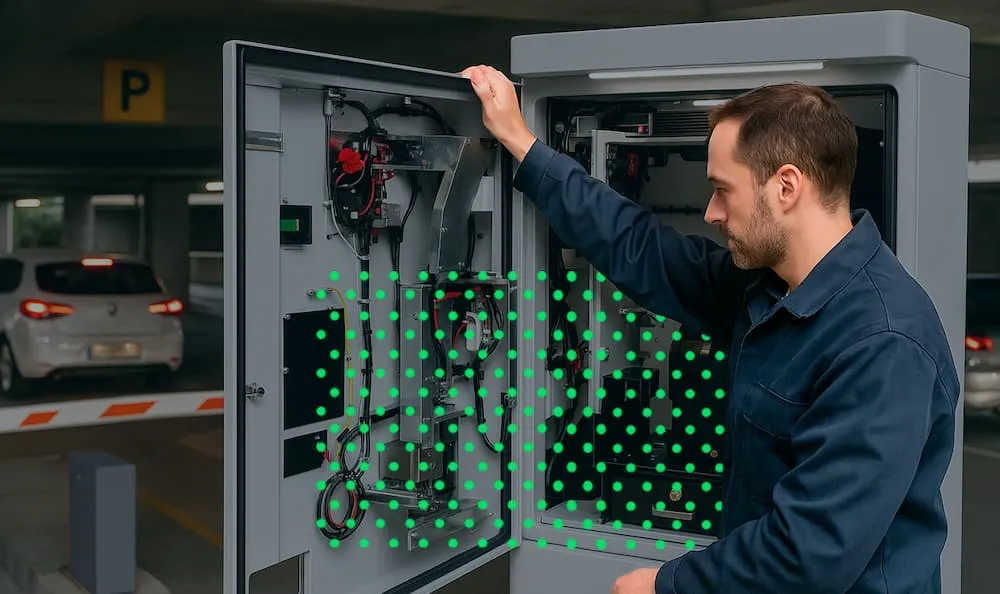
Pay stations contain several components requiring specific checks.
Depending on model, they can include receipt printers, touchscreens, card readers and cash acceptance or dispensing mechanisms.
Typical checks include:
- Cleaning and testing printing mechanisms.
- Inspecting cash acceptors and dispensers where present.
- Testing card recognition and payment.
- Checking displays and user controls.
- Reviewing power and communications.
Cash handling, electrical and internal mechanical work must follow authorised procedures.
The aim is to identify issues that could prevent customers from paying.
Intercoms and pedestrian access
Intercoms let customers request help.
Test connection, sound quality and, where applicable, links between calls and door or barrier operations.
Controlled pedestrian entrances also require checks of readers and permissions.
A failure may leave vehicle access functional while affecting customer assistance or accessibility.
Software and connectivity
Digital components also require maintenance.
Check communications between terminals and servers, error logs and software versions where relevant.
Updates should be scheduled and installed only when tested and compatible.
Automatically installing the newest available version is not always advisable without confirming stability and hardware compatibility.
How often should parking equipment be maintained?
There is no universal schedule.
Frequency depends on equipment type, usage, environment, manufacturer instructions and incident history.
A printer processing hundreds of tickets daily may require more attention than one used occasionally.
Dust, moisture and mechanical operating conditions also affect frequency.
Three useful levels are:
Routine staff observations. Identify visible issues, warnings or repeated faults without accessing components that require technical authorisation.
Periodic operational reviews. Examine logs, recurring errors and reports to determine whether inspections should be brought forward.
Scheduled technical visits. Qualified technicians inspect, clean, adjust and test devices included in the maintenance plan.
At i+d3, preventive visits may be annual, six-monthly or quarterly depending on the contract and site.
Schedules should follow actual requirements rather than an identical calendar for every facility.
How to organise a preventive maintenance plan
An effective plan defines which equipment to inspect, when to visit and how to record work.
1. Create an equipment inventory
List barriers, terminals, payment machines, cameras, servers and other components, with model details and technical documentation.
2. Define the necessary checks
Choose procedures according to each device and manufacturer instructions.
Assign technical tasks to personnel with suitable training and permissions.
3. Schedule visits
Coordinate inspections with parking operations to limit disruption.
If a device must be taken out of service temporarily, arrange this with facility managers.
4. Record the results
Document checks, adjustments and unresolved issues after each visit.
Photos and references may be included where useful.
5. Follow up on findings
Do not close an inspection merely because equipment still works.
Record worn parts and recurring abnormalities for repair, replacement or observation.
This history informs future visits.
Practical example: identifying a problem before a breakdown
Imagine a pay station printer developing occasional print errors.
Although it continues working, staff record several warnings.
At the next preventive visit, a technician checks the mechanism and finds debris that needs cleaning.
After cleaning, they test the printer.
This illustrates how minor recurring incidents can reveal maintenance needs before a more serious interruption.
It does not guarantee that the printer will never fail again.
Illustrative example; not a measured result from a specific installation.
How to tell whether preventive maintenance works
Track incidents and compare equivalent periods.
Measures can include breakdowns per device, recurring faults, corrective interventions and equipment downtime.
Also monitor whether issues identified during inspections were resolved or remain open.
This helps evaluate whether inspection frequency and scope are appropriate.
Changes in traffic, machinery or other conditions may also affect faults, so do not automatically attribute every improvement to maintenance.
i+d3's Preventive Maintenance Service (SMP)
i+d3 provides the Preventive Maintenance Service (SMP) for parking technology equipment.
During scheduled visits, technicians inspect devices within the contracted service, paying particular attention to wear-prone components such as printers, coin mechanisms, banknote acceptors and access devices.
They may also check connections, adjust equipment and review software versions depending on the site.
Interventions are documented to support ongoing equipment monitoring and future inspections.
SMP can be combined with the Remote Assistance Service (SAR) for technical support and certain incidents.
Frequency, coverage and conditions are defined by the contract.
Frequently asked questions about parking preventive maintenance
What car park equipment needs preventive maintenance?
It depends on the installation. Barriers, entry and exit terminals, payment machines, cameras, readers, intercoms and associated IT systems commonly require inspection.
How often should a parking pay station be checked?
Frequency depends on model, use and manufacturer recommendations. Components subject to wear may need more frequent checks.
Does preventive maintenance eliminate breakdowns?
No. It aims to identify anomalies and reduce risk through planned inspections, but cannot prevent all unexpected faults.
What is the difference between preventive and corrective maintenance?
Preventive work is scheduled to preserve equipment and detect issues. Corrective work repairs existing failures.
Does preventive maintenance include replacing parts?
It depends on service terms. An inspection may identify a part needing replacement, but supply and installation depend on agreed coverage.
Equipment maintenance is part of effective parking management
Preventive maintenance provides visibility into equipment condition and helps plan work before issues disrupt services.
A useful plan must suit installed systems, use appropriate intervals and record interventions.
At i+d3, we provide technical services supporting operators throughout the life of parking systems.
Need to schedule equipment inspections? Explore our parking support and maintenance services and ask about options for your facility.