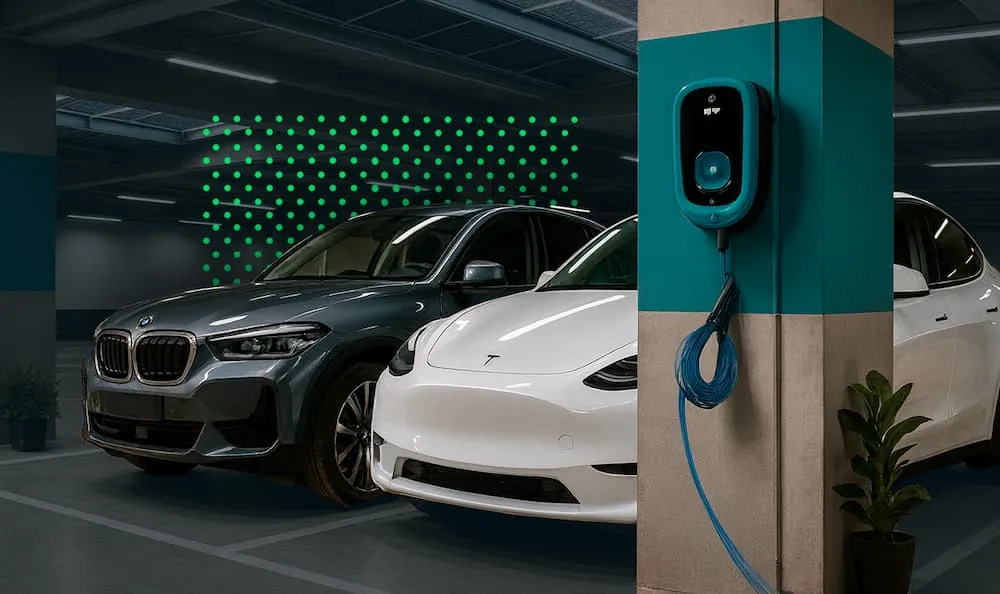
How to reduce your carbon footprint with a sustainable parking
The fight against climate change and the need to build more livable cities have placed sustainability at the center of urban mobility. Parkings, traditionally seen only as spaces to park, can become key infrastructures to reduce emissions, optimize resources, and improve the user experience. Thus, they give way to the concept of sustainable parking.At i+D3 we work on solutions for parkings that make them not only efficient but also environmentally friendly. Below, we review the main strategies to achieve this.
Ticketless: reduce waste and simplify processes
One of the most immediate steps towards sustainable parking is to eliminate the use of paper. With the ticketless parking system you achieve:
- Less resource consumption: ticketless systems eliminate ticket printing, reducing deforestation and the energy footprint associated with paper production.
- Smoother operation: in addition to environmental benefits, ticketless entry and exit minimizes queues and wait times. Thus, it implies less energy consumption within the parking lot.
- Digital experience: access via license plate, QR, or app transforms the passage through the parking lot. In this way, it becomes an agile, contactless process aligned with current user expectations.
Electric mobility: chargers that add efficiency
The transition to the electric vehicle is unstoppable. Since 2023, parkings with more than 20 spaces are obliged to have charging points. Therefore, it turns these facilities into key players in sustainable mobility.
- Regulatory compliance: the regulations require one charger for every 40 spaces and an extra one for every 100. Thus, it facilitates parkings becoming urban energy nodes.
- Installation without construction: chargers such as WallBox, WallBox Duo, or Vertica can be easily installed and managed from a centralized panel.
- Added value for the customer: offering charging not only contributes to decarbonization. Furthermore, it attracts conscious users and builds loyalty among those seeking comprehensive mobility solutions.
Smart guidance: fewer turns, fewer emissions
A driver driving around looking for a space not only loses time: they also pollute. Parking guidance systems significantly reduce this impact.
- Sensors in each space: they detect occupancy in real time and guide the user to the nearest free space.
- Emission savings: less internal traffic means less fuel consumption and fewer CO₂ emissions.
- Better operational management: the collected information helps plan occupancy, detect patterns, and adapt management strategies.
Dynamic pricing: data-driven efficiency
Digitalization allows applying variable rates according to demand. This strategy not only improves profitability but also helps to better distribute occupancy.
- Real-time prices: adjusted based on time, day, or local events.
- More efficient trips: by avoiding saturation peaks, users find spaces more easily, reducing unnecessary turns and traffic.
- Urban planning: a smart pricing system turns the parking lot into part of the solution to mobility, not the problem.
Smart access control with 4Park
The 4Park platform integrates multiple functionalities that reinforce the sustainability of any parking lot.
- Contactless access: technologies such as LPR (license plate reading), QR codes, or mobile apps eliminate physical supports and reduce associated consumption.
- Modular design: adaptable to urban, hotel, or caravan parkings, expanding functions without replacing existing infrastructure.
- Remote management: monitoring access, occupancy, and incidents remotely avoids unnecessary staff travel and optimizes resources.
- Connectivity with smart cities: integration with urban platforms allows coordinating the parking with the overall mobility of the city.
Durable and efficient equipment for sustainable parking
There is no sustainability without durability. At i+D3 we bet on parking equipment that optimizes the use of resources throughout its useful life.
- Robust automatic barriers: designed to withstand years of intensive use, they reduce the need for frequent replacements.
- Connected kiosks and ATMs: with remote diagnostics, avoiding unnecessary trips for maintenance.
- Long-term savings: fewer spare parts, less waste, and more efficient operation. It translates into a lower carbon footprint and a faster return on investment.
Transform your sustainable parking with i+D3
A sustainable parking is not only a benefit for the environment: it is also a competitive advantage. By incorporating these parking solutions, facilities reduce their carbon footprint. Likewise, they improve the user experience and prepare for the future of mobility.At i+D3 we believe that every parking lot can become an agent of change towards cleaner and more efficient cities.
Do you want to transform your facility into a sustainable parking?
Contact us and let's design together a sustainability plan tailored to your parking lot.